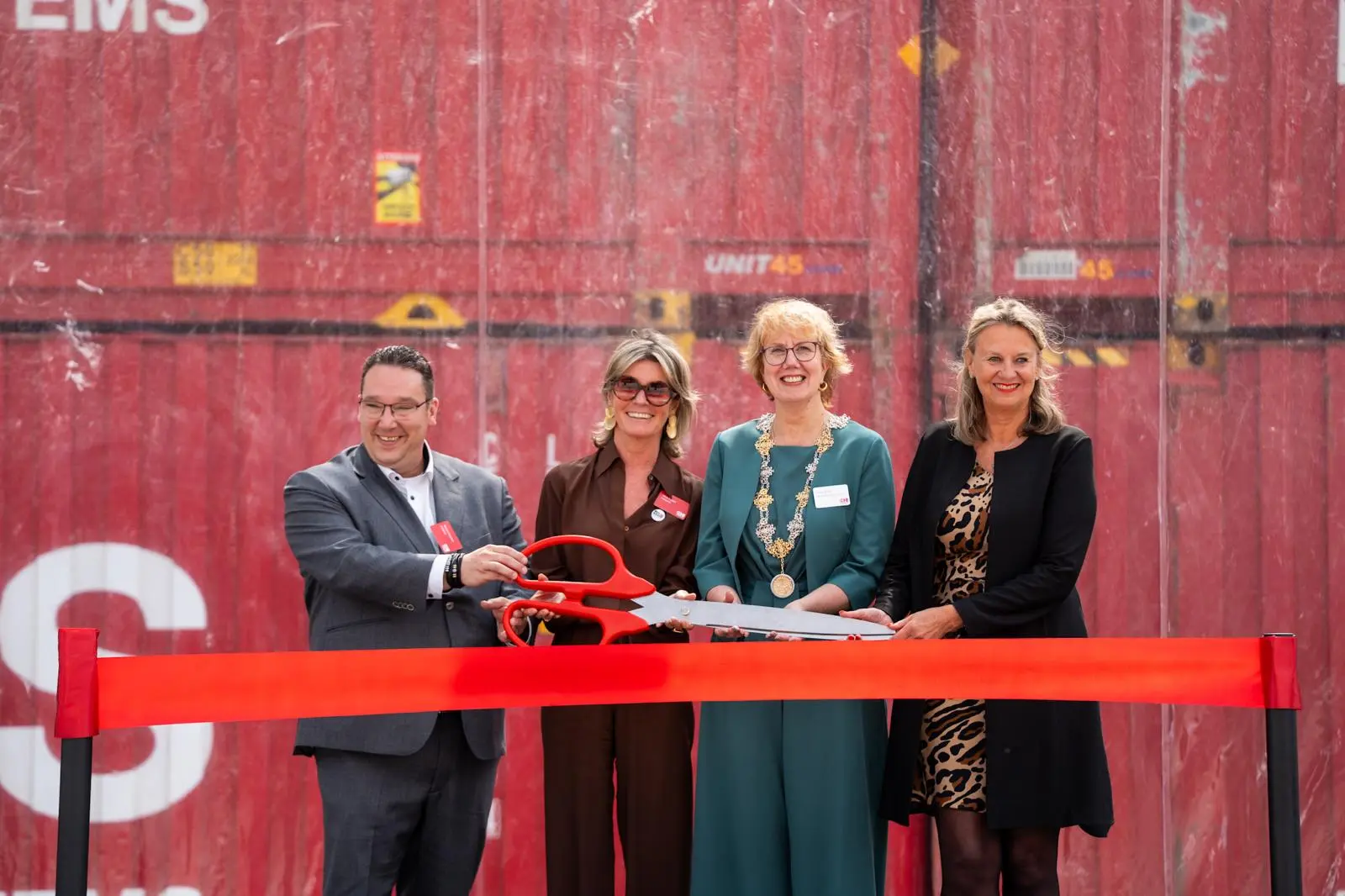
Bergen op Zoom, June 9, 2026 - Logistics service provider H.Essers officially opened the H.Essers Container Terminal in Bergen op Zoom today. Strategically located on the Scheldt-Rhine Canal, between the Port of Antwerp-Bruges and the Port of Rotterdam, the terminal will serve as a consolidation hub on the North Sea–Rhine–Mediterranean corridor, one of Europe’s most important transport routes. With an investment of 75 million euros and an annual capacity of 325,000 TEU, H.Essers is further expanding its focus on inland waterway transport for European container shipping. The new terminal will also immediately replace the existing inland terminal in Bergen op Zoom.
A terminal tailored to the European corridor
The new terminal features 350 meters of quay, a 6.5-hectare site, and storage capacity for 2,500 containers, including facilities for refrigerated cargo and ADR goods. In addition, 40,000 m² of extra warehouse capacity is planned, bringing H.Essers’ total warehouse space in Bergen op Zoom to 200,000 m². Two inland waterway connections depart daily from the H.Essers Container Terminal toward Rotterdam and Antwerp. The site directly employs 150 people and indirectly supports another 300 jobs.
Location outside the dikes makes all the difference
What sets the new terminal apart is its location. The old terminal was located inside the dikes, behind the Burgemeester Peterssluis and a narrow channel, which meant that only smaller inland vessels could reach the quay. Moreover, operations were dependent on the bridge operator’s working hours. The new H.Essers Container Terminal is located outside the dykes, directly on the Scheldt-Rhine Canal, and is therefore accessible 24/7 to larger vessels.
This has direct implications for how containers move across Europe. Antwerp-Bruges and Rotterdam enforce minimum call sizes for inland vessels calling at their terminals. Antwerp-Bruges and Rotterdam enforce minimum call sizes for inland vessels calling at their terminals. Ships must dock with a certain minimum number of containers to operate the quays efficiently, especially now that both seaports are struggling with increasing congestion and every docking must be carefully scheduled. From an inland terminal, that volume is often not feasible, resulting in containers still having to be transported by road to the seaports. The H.Essers Container Terminal, located outside the dike, addresses this problem: smaller inland waterway shipments are consolidated here onto larger vessels that do meet the required call sizes. This way, the containers remain on the water from start to finish.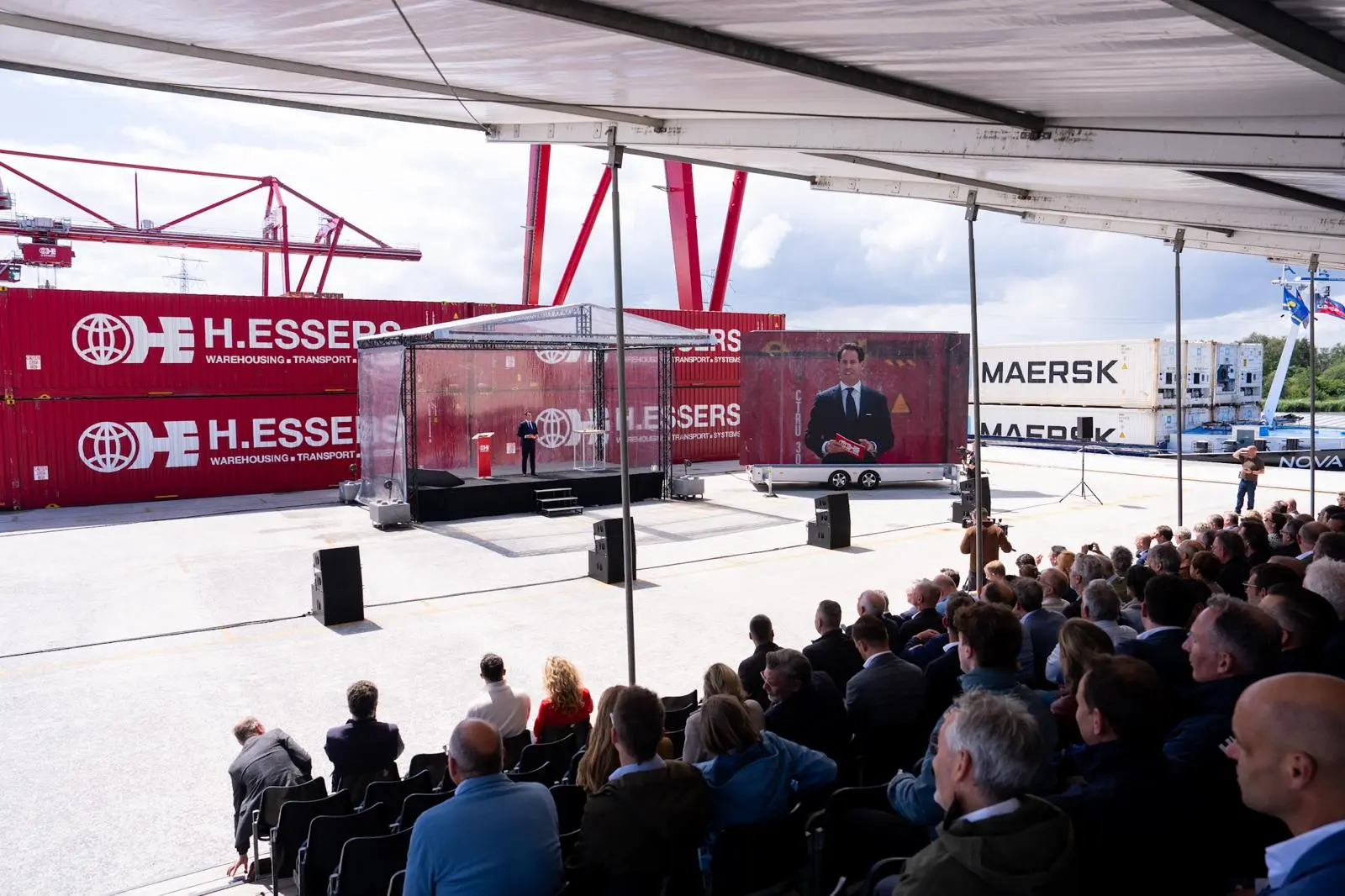
A new step in the modal shift
With the new H.Essers Container Terminal in Bergen op Zoom, H.Essers continues its synchromodal strategy: transporting cargo in the most efficient way by making optimal use of the various modes of transport (road, water, and rail) and increasingly opting for inland waterway transport. Inland waterway transport consumes significantly less energy per ton-kilometer than road transport and simultaneously relieves pressure on a European road network that is increasingly reaching its limits.
“The H.Essers Container Terminal is more than just an infrastructural milestone. With this location between Antwerp and Rotterdam, right on the North Sea–Rhine–Mediterranean corridor, we are opting for a logistics model that is less dependent on road transport and fully integrated into the major European corridors. For our customers, this means faster and more predictable connections between Antwerp and Rotterdam. For the region and for Europe, it means less pressure on the roads and a lower carbon footprint per container.”
Addressing environmental impact on multiple levels
The terminal was designed with attention to the ecological impact on multiple levels. Operationally, the site uses zero-emission gantry cranes and 19,000 solar panels. Moored ships can shut down their diesel generators using shore power during port stays. In the long term, the site will also be equipped as a charging point for the electrified inland shipping of the future.
The location outside the dike also results in a significant reduction in nitrogen emissions: because ships no longer have to pass through the lock and under the bridge, loading, unloading, and turning are more efficient, which noticeably reduces emissions per container handled. On the broader road network, the modal shift translates into a daily reduction of approximately 260 truck movements in and around Bergen op Zoom.
Finally, environmental integration was also carefully addressed. The terminal is situated between two Natura 2000 zones, which resulted in an environmental offset of 1.5 hectares of reed beds that were relocated and transformed into three new islands in the surrounding water area.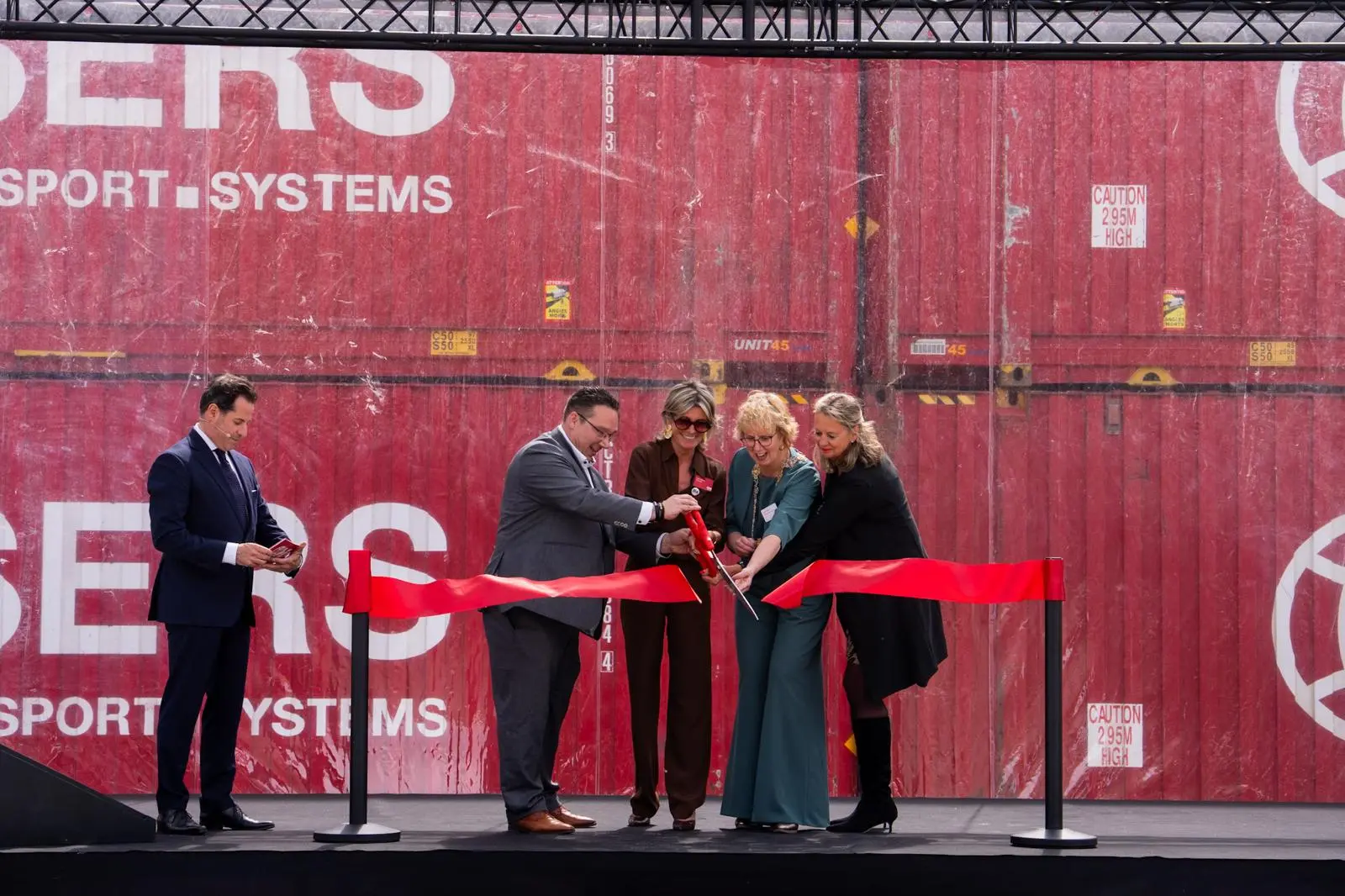
Strategic growth for H.Essers
The new terminal complements H.Essers’ existing services in the region, including customs clearance, storage of hazardous substances, and value-added activities such as filling. As a result, the site plays a central role in H.Essers’ Dutch growth strategy, a process that accelerated following the acquisition of the chemical activities of the Meeus Group.
Impact on the region
“As a company, we are increasingly focusing on inland waterway transport. The improved accessibility of the new terminal via the Scheldt-Rhine Canal also reduces traffic congestion through the built-up area.”
The relocation also benefits current local residents: more and more residential areas have sprung up around the old terminal. That site is now being transferred to the municipality for a new use. The H.Essers Container Terminal itself is now located entirely outside the built-up area.
“With the opening of H.Essers’ offshore container terminal, we are taking an important step in Bergen op Zoom toward a sustainable and future-oriented logistics sector. This investment underscores and strengthens our position on one of Europe’s most important transport corridors.
Bergen op Zoom is thus once again connecting with its rich history as a logistics and economic hub in the Flemish-Dutch Delta between Antwerp and Rotterdam. For centuries, our city has served as a gateway between the sea and the hinterland, a tradition of connection, trade, and entrepreneurship that we are continuing today in a contemporary form.
At the same time, this project means a great deal to our residents and businesses. It creates valuable jobs, strengthens our regional economy, and contributes to a better, more sustainable living environment by shifting transport from road to water. It is a powerful example of how economic development and quality of life can go hand in hand.”
H.Essers was founded in 1928 by Henri Essers and has since become one of the leading companies in Europe for logistics services for sectors such as chemicals and healthcare. In recent years, the company has experienced solid expansion thanks to organic growth and a number of strategic acquisitions. In 2025, H.Essers booked an annual turnover of over one billion euros. The company currently has more than 1,300,000 m² of warehouse space, a fleet of 1.358 trucks, 4.013 trailers, 728 Safeboxes and 1.624 ISO tanks. Over 50% of this fleet is multimodal. More than 6.600 people work at H.Essers, in 66 locations and 14 countries worldwide. Learn more at www.essers.com
H.Essers Opens New Container Terminal in Bergen op Zoom and Strengthens Sustainable Logistics Corridor Between Antwerp and Rotterdam